


Franciscan Friar Fr. Paul Gallagher reflects on the Gospel readings for the Fourth Sunday of Advent. How do you experience God speaking to you in your life journey?
As we near the feast of the Incarnation, Franciscan Sisters of Christian Charity wish to thank publicly the teamwork of Fr. Paul Gallagher, Joseph Theil and Sister Anne Marie Lom. Each week this year, they have prayed and reflected on the Gospel readings with us. We couldn’t offer this blogpost gift to you without them. May the Lord bless you.
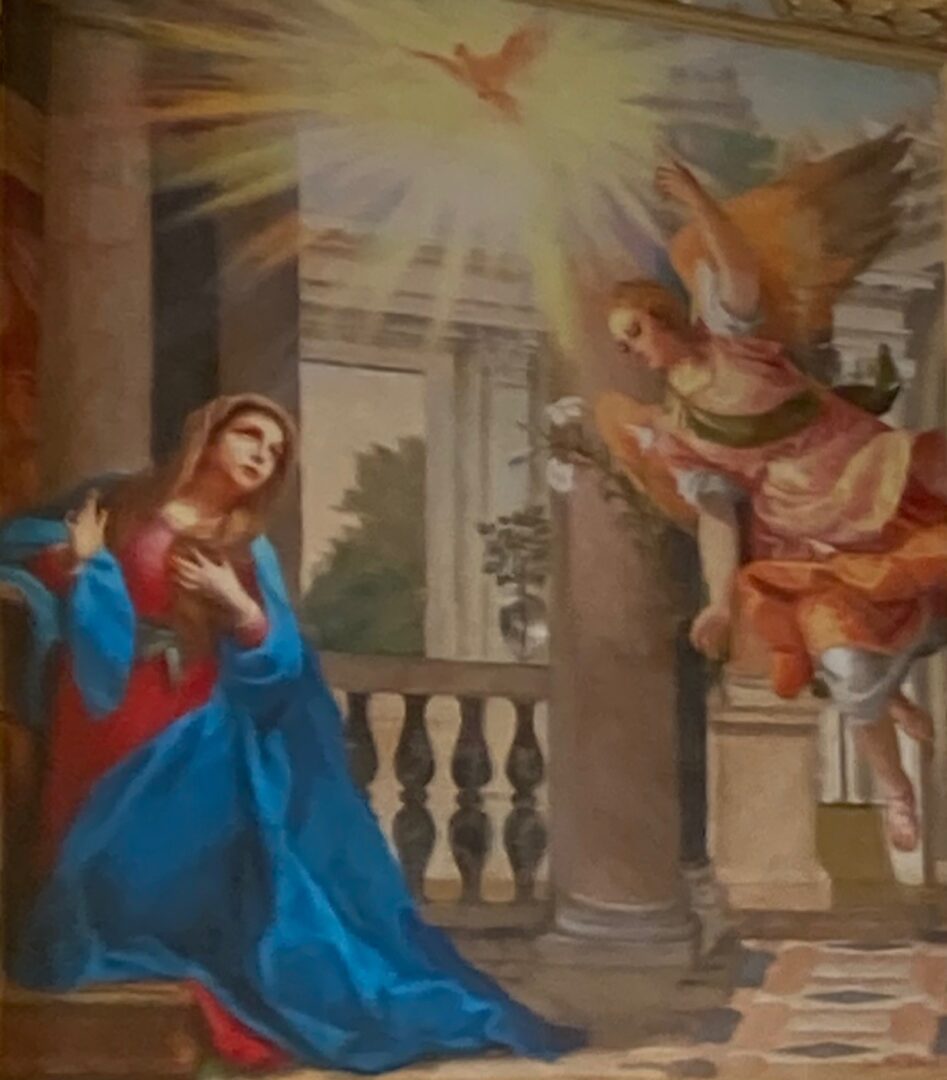
The content is edited by Franciscan Sister of Christian Charity Sister Anne Marie Lom and Joe Thiel. The excerpts from the Sunday readings are prepared by Joe Thiel. To read or download the complete pdf with excerpts for your prayer, please click here: Franciscan Gospel Reflection December 21 2025. Excerpts are from the Lectionary for Mass for Use in the Dioceses of the United States of America, second typical edition © 2001, 1998, 1997, 1986, 1970 Confraternity of Christian Doctrine, Inc., Washington, DC. Used with permission. All rights reserved. No portion of this text may be reproduced by any means without permission in writing from the copyright owner. Photo: Diocese of Tuscon Chapel ceiling, painting of the engagement of Mary and Joseph from Holy Family Convent, Manitowoc, Wisconsin
Matthew 1:18-24
Now this is how the birth of Jesus Christ came about. When his mother Mary was betrothed to Joseph, but before they lived together, she was found with child through the Holy Spirit.
Joseph her husband, since he was a righteous man, yet unwilling to expose her to shame, decided to divorce her quietly. Such was his intention when, behold, the angel of the Lord appeared to him in a dream and said, “Joseph, son of David, do not be afraid to take Mary your wife into your home. For it is through the Holy Spirit that this child has been conceived in her. She will bear a son and you are to name him Jesus, because he will save his people from their sins.”
All this took place to fulfill what the Lord had said through the prophet: “Behold, the virgin shall be with child and bear a son, and they shall name him Emmanuel,” which means “God is with us.” When Joseph awoke, he did as the angel of the Lord had commanded him and took his wife into his home.
Background:
The focus of the Gospel text for the Fourth Sunday of Advent is on the birth of Jesus. Matthew’s Gospel is the only text that has Joseph as the central figure in the story of Jesus’ nativity. It is Joseph who is described as a righteous man, whom the angels appear to in a dream, who first receives the news that Mary is pregnant with a highly favored male child, that he is to name the child Jesus, and that this child will be the fulfillment of all that the prophets had spoken of. Matthew’s focus on Joseph is a significant departure from what most are accustomed to.
Everyday life in Matthew’s community was gender separated, even for those who were married. Marriages were arranged, negotiated by the women and confirmed by patriarch, to make sure that the agreement was fair for both families. The primary concern was how the two families would fare economically and politically through this marriage. When all was settled, the marriage was announced and the period of betrothal began. The bride prepared to leave the house of her father, and the groom prepared a place for his bride in the house of his father. Although the couple did not live together, they were considered married during the betrothal. If one should die, the other was considered a widow or widower. Engaging in a sexual relationship outside of this relationship was considered adultery. Betrothal was the beginning of the marriage process that ended with the groom taking the bride into his house and consummating their marriage.

In the text, Joseph is described as a righteous man. Being a righteous man within Matthew’s community meant that he faithfully observed the law of Moses. According to Deuteronomy, Joseph should have had Mary stoned, because if the child did not belong to Joseph, the pregnancy must have been the result of her having committed adultery with another.
“If within the city a man comes upon a maiden who is betrothed, and has relations with her, you shall bring them both out to the gate of the city and there stone them to death: the girl because she did not cry out for help though she was in the city, and the man because he violated his neighbor’s wife. Thus, shall you purge the evil from your midst.” (Deut 22:23-24)
Even though Joseph has taken great pains to be faithful to the law, he is also man of compassion, and he decides to divorce Mary quietly. Perhaps he feels this would allow the true father of the child could come forward and claim the child as his heir. It is at this point that an angel appears to Joseph in a dream, and he learns that Mary’s pregnancy was due to the intervention of the Holy Spirit, that the child was a highly favored male, and that he, Joseph, is to name him Jesus.
Changing one’s course of action because of a dream may be odd in the contemporary world. However, ordinary people like Joseph and Mary believed that God spoke to them in ordinary ways. Dreams were considered an ordinary part of each person’s life and awareness. As a result of his dream, Joseph took Mary into his house as his wife and gave the child the name Jesus, as he had been instructed. In doing so he was claiming him as his own son.
Because of the many Church feasts associated with Mary, the Church has given us many opportunities to reflect on Mary’s surrender and her role in God’s plan. Matthew in this Gospel places Joseph as the central figure in God’s plan to come among us as the incarnate presence of God. Joseph also gave up his own plans, and his hopes to create his own family, name his own son, and have his own offspring to carry on his family line. Instead, he accepted God’s plan. He accepted God’s family and made it his own. It is one thing to have faith that God is working in this very unique situation, but it is another to surrender one’s own desire and plans for one’s own life in order to cooperate with what God is doing. This can be even more difficult when one has lived his life trying to be faithful to the law and the path to living a life in relationship with God’s desire. Artists at times picture Joseph as an older man, giving the impression that he is near the end of his natural life, past the time of a young man with dreams for his future. The Church, by placing this Gospel text on the last Sunday in the Advent season, is inviting us to reflect both on Joseph as a model for our own preparation for Christmas, and also how we are preparing for the second coming and the fullest presence of God.
Reflection Questions:
- How do you experience God speaking to you in your life journey?
- Has there been a time when God seemed to be present to you in a dramatic circumstance?
- How has God been present to you during this Advent season?
- Have you ever changed the direction of your life because of some experience of God’s presence?
- The Gospel describes Joseph as a person who lived his life trying to be faithful to the law of Moses. Do you know people who live their life trying to be faithful to their faith tradition?
- Can you imagine any of them putting aside what they believe from that tradition to act in the way that Joseph does toward Mary in this Gospel?
- What kind of soul-searching do you think Joseph did before he made his decision to accept Mary as his wife and Jesus as his son?
- Can you take some time now to talk with God about your impression of Joseph, and what it is saying to you at this point in your own life?
The post Fourth Sunday of Advent 2025 Franciscan Gospel Reflection appeared first on Franciscan Sisters.